Domestic Violence Emergency Hotline April 2026 Data and Analysis Report
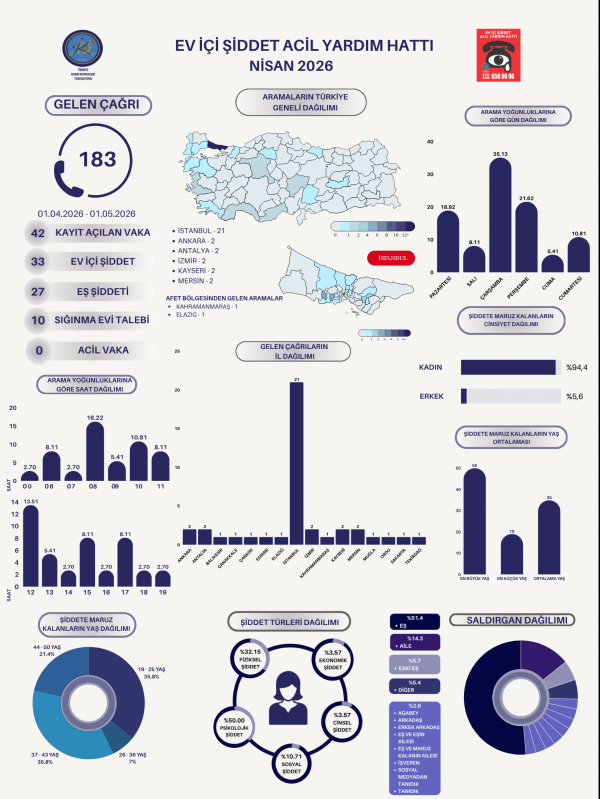
The Domestic Violence Emergency Helpline, operated by the Türkiye Kadın Dernekleri Federasyonu (TKDF), received a total of 183 calls between April 1-30, 2026. Of these, 21 calls originated from İstanbul, followed by 2 calls each from Ankara, Antalya, İzmir, Kayseri and Mersin. In total, calls were received from 16 different provinces, listed as follows:
ANKARA:2 ANTALYA:2 BALIKESİR:1 ÇANAKKALE:1 ÇANKIRI:1 EDİRNE:1 ELAZIĞ:1 İSTANBUL:21 İZMİR:2 KAHRAMANMARAŞ:1 KAYSERİ:2 MERSİN:2 MUĞLA:1 ORDU:1 SAKARYA:1 TEKİRDAĞ:1
The remaining calls were follow-ups to ongoing cases. The distribution of calls in İstanbul, which received the highest number of calls, is as follows by district:
ARNAVUTKÖY:1 AVCILAR:1 BAĞCILAR:1 BAKIRKÖY:1 BEYLİKDÜZÜ:1 ÇEKMEKÖY:1 ESENYURT:3 EYÜP:1 GAZİOSMANPAŞA:1 GÜNGÖREN:1 KÜÇÜKÇEKMECE:3 SANCAKTEPE:2 SARIYER:1 SULTANBEYLİ:1 ŞİŞLİ:1 ÜSKÜDAR:1
The distribution of calls demonstrates that violence reports have been received from cities and districts of varying development levels and socioeconomic statuses.
From October 15, 2007, to the present day, the Domestic Violence Emergency Hotline has received a total of 101,759calls. These include reports from all provinces of Türkiye and from numerous countries including Germany, France, Finland, Portugal, Saudi Arabia, Italy, Austria, Azerbaijan, Belgium, the Netherlands, Australia, the United States, Syria, Switzerland, Iran, Tunisia, the United Kingdom, Sweden, Romania, Libya, Japan, Ukraine, Georgia, Kenya, Canada, Kazakhstan, Greece, China, the United Arab Emirates, Iraq, Denmark, Kyrgyzstan, Brazil and Cyprus.
Out of 42 newly recorded cases of violence reported during this period, 33 were classified as domestic violence. Among these, 27 were incidents of intimate partner violence perpetrated by legal spouses. 10 callers requested shelter. No casesrequired immediate intervention. Legal information was provided in response to 40 calls. 23 calls were referred to the police and 7 to bar associations. 2 calls regarding the non-consensual sharing of intimate images were referred to the StopNCII.org platform. 1 call was referred to a lawyer within the scope of the ILO C190 Convention on the Elimination of Violence and Harassment in the World of Work.
The age range of those subjected to violence was between 19 and 50 years. In some cases, the informants did not know the exact age of the victims.
The calls indicate that the vast majority of those subjected to violence are women (94.4%), followed by men (5.6%).
The majority of reported cases involved psychological and physical violence (psychological violence: 50.00%, physical violence: 32.15%). Additionally, 10.71% of calls involved social violence, 3.57% sexual violence, and 3.57% economic violence.
It is important to note that while analytical categorizations separate these types of violence, in reality, multiple types often coexist. Victims often report the type(s) that have the most immediate or profound impact. Many may not recognize forms of violence beyond the physical, and even if they do, they may not perceive them as serious or urgent enough to report or seek help for.
The calls received by the Domestic Violence Emergency Hotline continue to demonstrate that women are most often subjected to violence by men closest to them. These acts of violence most frequently take place within the home, a space presumed to be safe. In April 2026, 51.4% of aggressors were reported to be legal husbands. Other family members, such as brothers, former spouse, the families of the spouse, and the survivor’s families were also named as perpetrators by victims or callers.
In 2011, the Istanbul Convention, which was opened for signature on May 11 and first signed by Türkiye, became one of the most significant international instruments in conveying to society that violence against women is not a “private matter,” but a human rights violation. The social awareness created during the period in which the Convention was signed marked an important turning point in making violence visible, enabling women to become aware of their rights, encouraging discussions on the responsibilities of institutions, and recognizing the state’s obligation to develop preventive policies.
However, following the decision to withdraw from the Convention, the political approach that emerged shifted the fight against violence away from a rights-based framework and reduced it to a family-centered and protectionist perspective. Yet policies that protect women’s right to life and efforts to strengthen the family are not contradictory; on the contrary, they are complementary. In an environment where violence is rendered invisible, women are isolated, and the perception of impunity continues to grow, it is not possible to strengthen social trust.
Calls received by the Domestic Violence Emergency Hotline also demonstrate that women continue to be subjected to violence by the men closest to them, while psychological and physical violence remain widespread. On the 15th anniversary of the Istanbul Convention, what is needed is the effective reimplementation of the principles of prevention, protection, prosecution, and policy-making set forth by the Convention. Because women’s right to life, equal citizenship, and a life free from violence are not open to debate; they are among the fundamental responsibilities of states.
